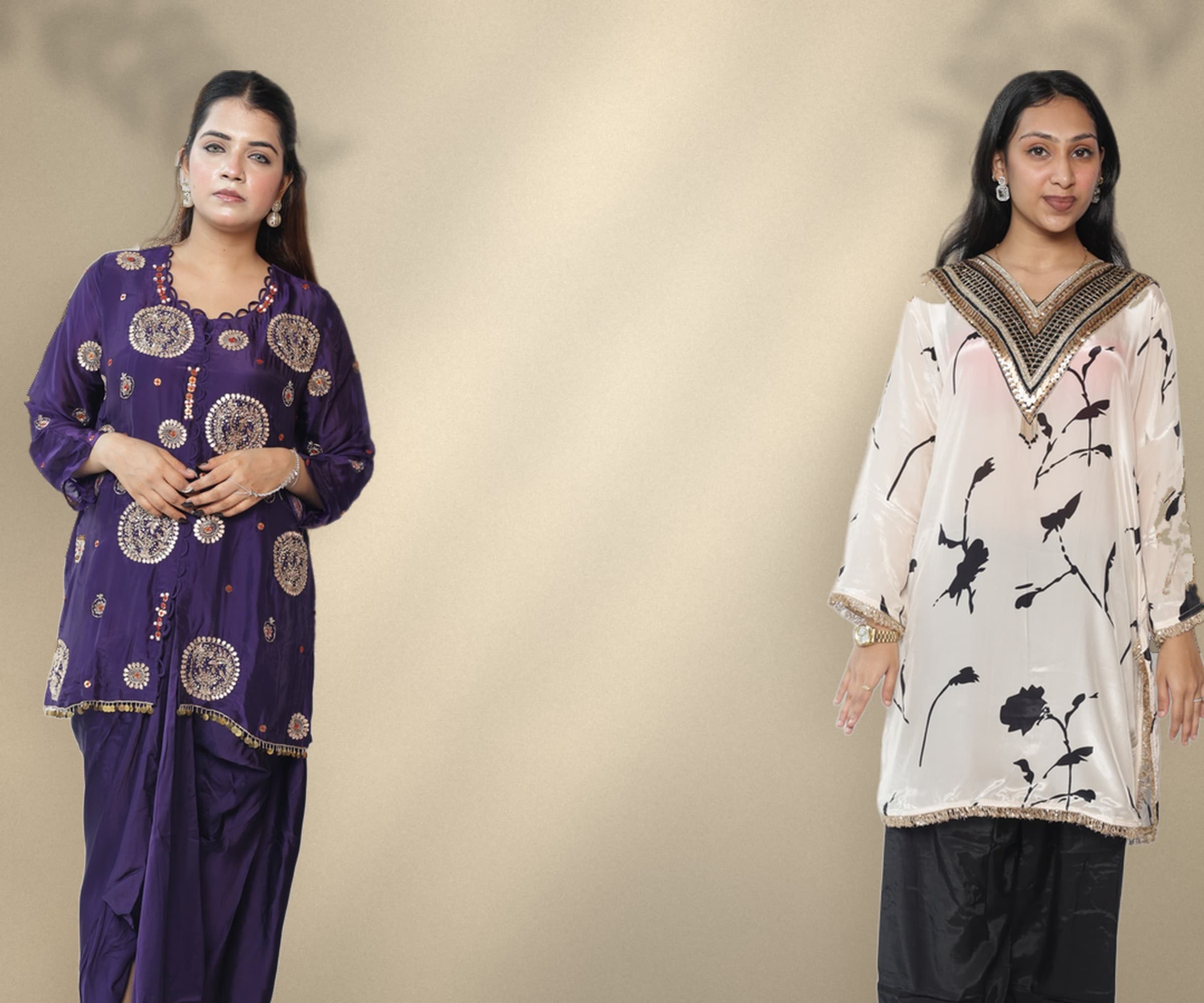
The difference between them is where the fullness starts and where it ends. A salwar is gathered at the waist and narrows to the ankle. A palazzo falls straight and wide from the hip. A sharara flares so widely that it hangs like a skirt, a gharara is fitted to the knee and flares below a joint there, and a farshi is cut so long and full that it reaches the floor. A churidar is narrow and long enough to bunch at the ankle, and a Patiala salwar falls in deep pleats.
Salwar
The classic. Cut wide at the waist, gathered with a drawstring, and tapered to a narrow cuff at the ankle, so it is loose where you sit and neat where it meets your shoes. It suits almost any length of kurta. The Sahar Satin Kurta Set pairs a navy satin kurta with a matching satin salwar, and the Nyra Ikat Kurta Set cuts its salwar in the same green ikat as the kurta.
Patiala salwar
Named after Patiala in Punjab, it uses far more fabric than a plain salwar, gathered into deep pleats that fall in folds from waist to ankle. It is usually worn with a short kurta, so the pleats show.
Churidar
Fitted through the leg and cut longer than the leg, so the extra length gathers at the ankle in rings — churi means bangle. It is the usual partner for an anarkali or a long, flared kurta.
Palazzo
Straight, wide-legged trousers that fall from the hip without gathering at the ankle. They are the easiest bottom to wear all day, and they suit long and short kurtas alike. Many of our co-ord sets are cut with palazzos, from the Amira Crepe Suit, whose palazzos are printed in the same fine toile as the kurta, to the Zeba Printed Crepe Co-ord Set.
Sharara
A trouser so wide that, standing still, it reads as a skirt. It is fitted at the waist and flares from there, or from the upper thigh, with no seam at the knee. Worn with a short kurti it has much of a lehenga's volume without the weight, which is why it is a favourite for sangeets and weddings. The Anisha Sharara Set pairs a purple georgette kurti with a full floral crepe sharara.
Gharara
The one most often confused with a sharara. A gharara is fitted from the waist to the knee, then flares out below a joint at the knee, which is usually covered by a decorative band of gota or embroidery. If there is a seam at the knee, it is a gharara; if the flare runs unbroken, it is a sharara. The gharara is traditionally associated with Lucknow, where it has long been worn at weddings.
Farshi
From farsh, the floor. The farshi pyjama of the nawabi courts of Awadh was cut so long and full that it trailed on the floor behind the wearer. Today the name is used more loosely for very wide, floor-length salwars and palazzos, worn under a long or a short kurta. Our Farshi pieces use it that way: long kurtas over full salwars, in chiffon, satin and printed ikat.
Straight pants
Narrow, straight-cut trousers that end at the ankle. They are the cleanest, most everyday option, and they leave the attention on a kurta with detail at the hem. The Suhana Textured Kurta Set, rust georgette pintucked into a raised lattice with a floral appliqué climbing the hem, is cut with matching straight pants.
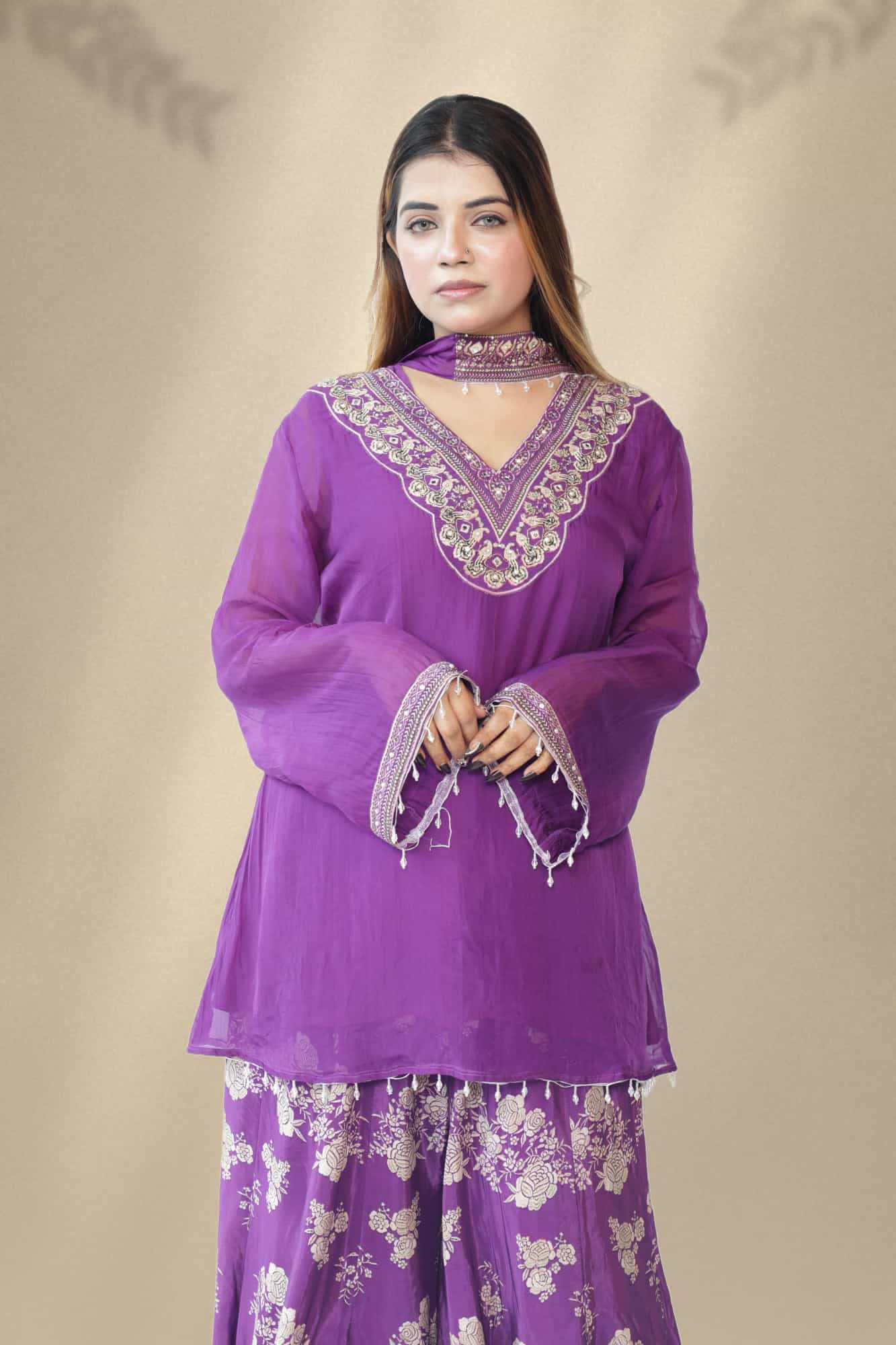
Anisha Sharara Set
₹34,000
₹23,900
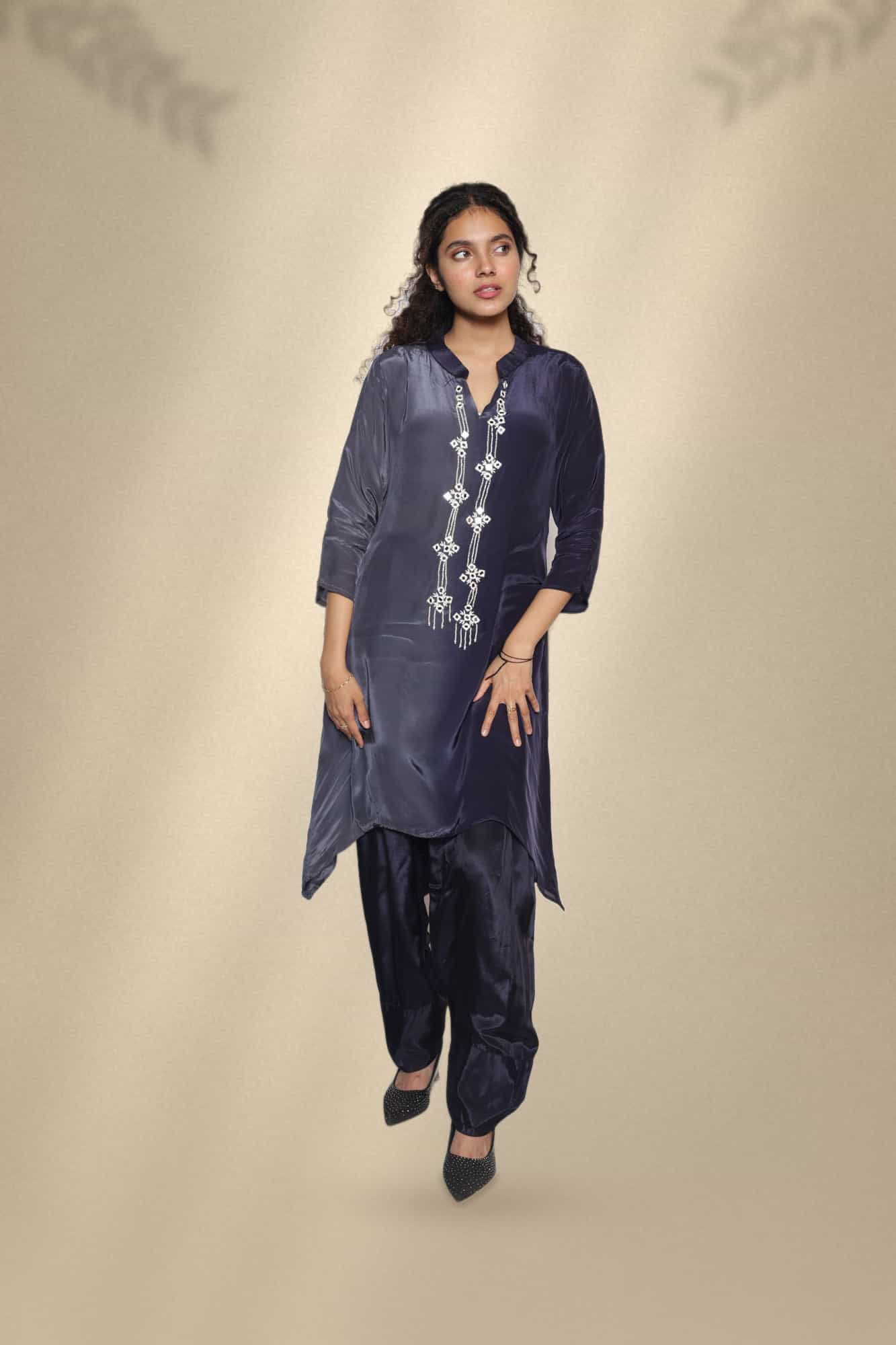
Sahar Satin Kurta Set
₹34,000
₹21,900
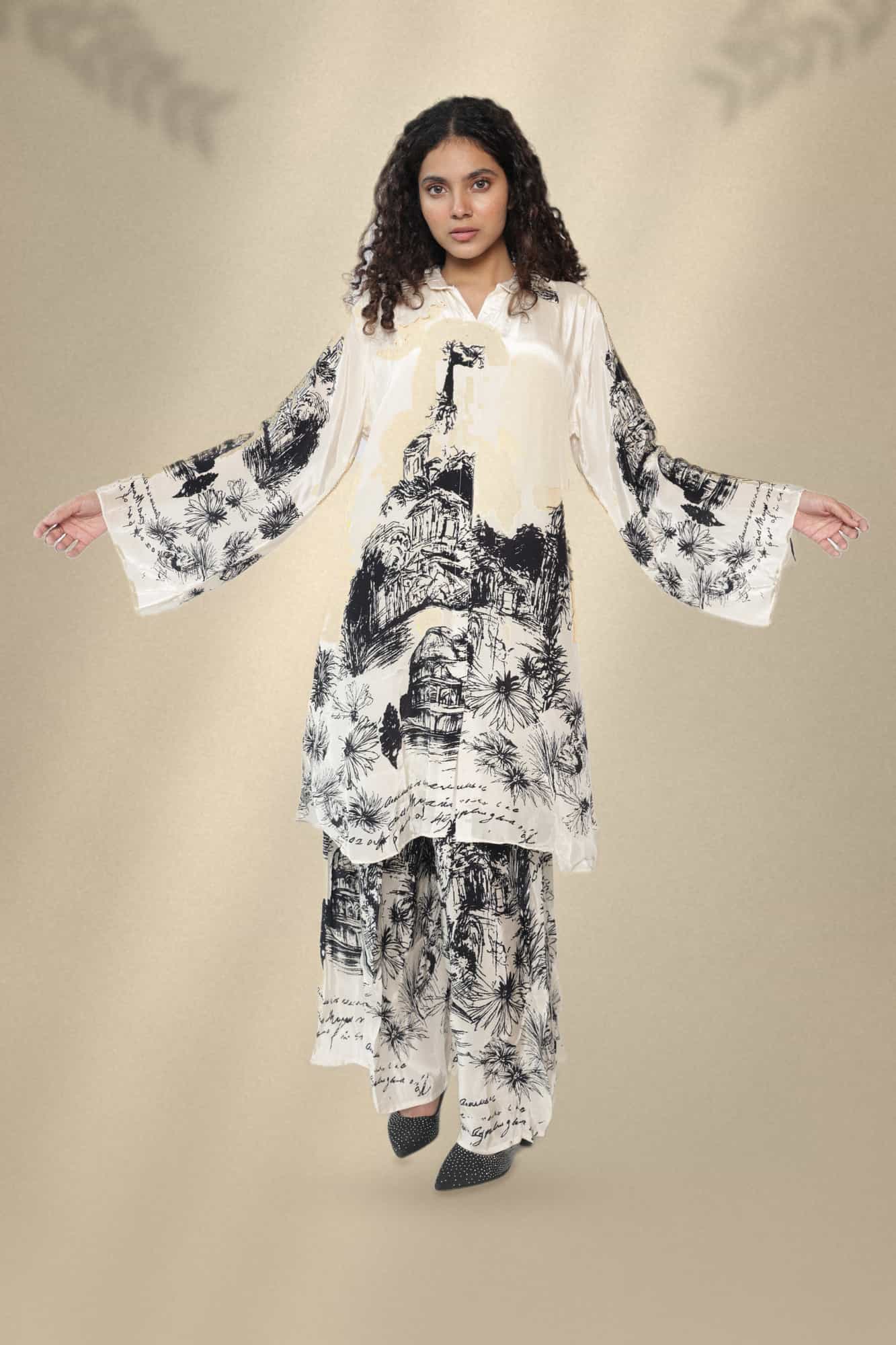
Amira Crepe Suit
₹34,000
₹21,900
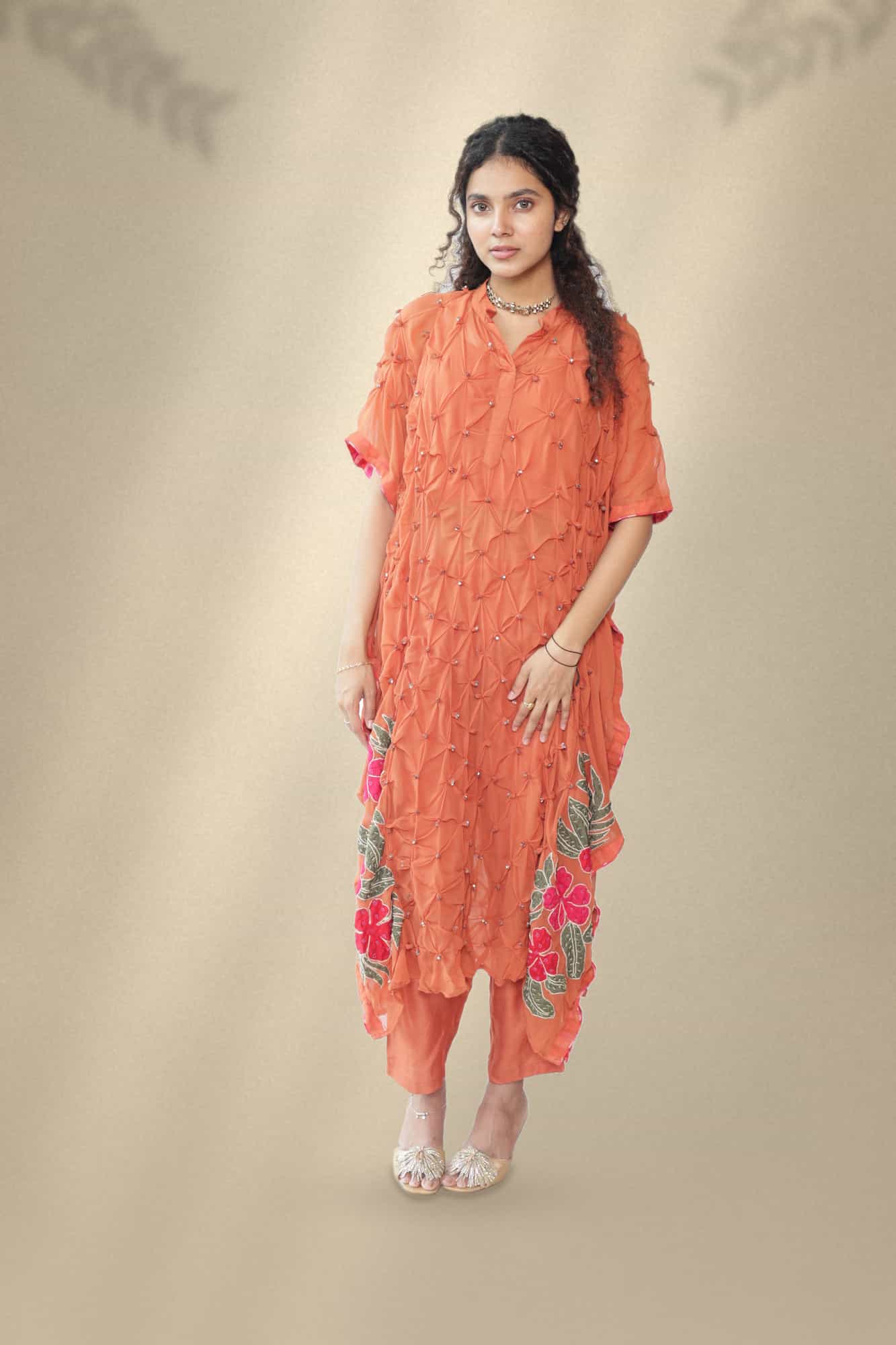
Suhana Textured Kurta Set
₹9,200
Which kurta goes with which
- Short kurti: a sharara, gharara, Patiala or farshi, where the volume of the bottom is the point.
- Mid-length kurta: a salwar, palazzo or straight pants.
- Long or flared kurta, or an anarkali: a churidar or straight pants, so the line stays narrow underneath.
- Kaftan: wide palazzos, which carry the same easy shape down to the floor, as in the Kiran Aztec Kaftan Set.
Which to wear when
- A long day, or travelling: a palazzo or straight pants.
- Mehendi or sangeet: a sharara or gharara, for movement.
- The wedding: a sharara, a gharara, or a salwar in a rich fabric.
- Work or every day: straight pants or a slim salwar.
For whole outfits by function, see what to wear to a mehendi and a sangeet and what to wear to an Indian wedding if you don't want a lehenga.